What subjects are taught in primary school?

Primary school forms the foundation of a child’s educational journey, setting the stage for everything that comes later. During these crucial years, typically spanning from ages five to eleven, children develop essential academic skills, social abilities, and a genuine love of learning. The subjects taught during this period aren’t chosen randomly—they’re carefully designed to build core competencies while nurturing curiosity and creativity.
The curriculum in primary school strikes a balance between traditional academic subjects and practical life skills. While the exact subjects vary slightly depending on your location and country, most primary schools follow a similar framework that emphasizes literacy, numeracy, and a broad understanding of the world. Understanding what your child will learn helps you support their education at home and appreciate the different ways teachers help them grow.
Core Academic Subjects
English and Literacy
English is typically the most time-intensive subject in primary school, and for good reason. During these years, children transition from learning to read to reading to learn. The focus starts with phonics in the early years—teaching children how letters combine to make sounds. Teachers use systematic approaches to help young learners decode words and understand letter patterns.
As children progress through primary school, their reading becomes more sophisticated. They encounter different text types: stories, poetry, information books, and even simple non-fiction. Comprehension becomes increasingly important, with teachers asking children not just to read words, but to understand meaning, predict what might happen next, and discuss characters’ feelings and motivations.
Writing instruction follows a similar progression. Early primary years focus on forming letters correctly and writing simple sentences. By the later years, children tackle longer pieces—short stories, recounts of events, and informative texts. Teachers emphasize spelling, punctuation, grammar, and the ability to organize thoughts coherently. Many schools incorporate handwriting practice throughout, as fine motor skills develop gradually.
Speaking and listening receive careful attention too. Teachers encourage children to participate in class discussions, listen to others’ ideas, and communicate their own thoughts clearly. Drama activities, show-and-tell sessions, and group work all contribute to developing confident speakers and attentive listeners.
Mathematics
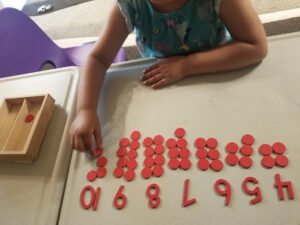
Mathematics in primary school builds number sense and problem-solving abilities from the ground up. Younger children start with counting, recognizing numbers, and understanding basic concepts like “more” and “less.” They work with manipulatives—physical objects like blocks, counters, and number lines—to make abstract ideas concrete.
Arithmetic forms a large part of primary mathematics. Children learn addition and subtraction first, then progress to multiplication and division. Teachers emphasize understanding why these operations work, not just memorizing facts. A child might use an array of objects to understand that 3 times 4 means 3 groups of 4, rather than simply accepting that the answer is 12.
Beyond arithmetic, primary school mathematics includes geometry (shapes, space, and position), measurement (length, weight, capacity, and time), and data handling (collecting and interpreting information). These topics help children see how mathematics applies to the real world. Measuring ingredients for a recipe connects to cooking, and tracking weather patterns connects to science.
Problem-solving is woven throughout mathematics instruction. Children work on puzzles and real-world scenarios that require them to think mathematically. This approach builds resilience and helps them see mathematics as a practical tool rather than a collection of abstract rules.
Science Education
Science in primary school encourages children to observe, ask questions, and investigate the world around them. Rather than focusing on memorized facts, good primary science teaching emphasizes hands-on exploration and curiosity.
The content typically covers life sciences, physical sciences, and earth sciences. In life sciences, children learn about living things—plants, animals, habitats, and how organisms grow and reproduce. They might grow seeds, observe insects, or learn about food chains. Physical sciences cover materials, forces, light, and sound. Children experiment with different materials to understand their properties, explore how things move, and discover how light and shadow work.
Earth sciences topics include weather, seasons, and the basic properties of rocks and soil. Children observe weather patterns, learn why we have seasons, and explore natural materials from the earth. The key approach is experiential: children are doing science, not just learning about it.
Scientific vocabulary is introduced gradually and purposefully. Teachers help children use precise language to describe observations and findings. Over time, children develop an understanding that science is a way of finding out about the world through careful observation and testing.
Humanities Subjects
History
History in primary school typically begins with the child’s own world before expanding outward. Early primary history focuses on families, communities, and local history. Children might learn about how their grandparents lived differently or explore their local neighborhood and its history.
As they progress, children study different time periods and civilizations. Ancient Egypt, the Romans, the Vikings, and other historical topics capture children’s imaginations. History teaching often connects to children’s interests—learning about explorers, famous figures, or how people lived in different eras.
The goal isn’t to memorize dates and facts, but to develop historical thinking. Teachers help children understand why people made certain choices, how life was different in the past, and how people adapt to their environments. Using primary sources—old photographs, letters, artifacts—makes history tangible and real.
Geography
Geography extends children’s understanding of the physical and human world. In early primary years, the focus is on the local area—the school, the neighborhood, and familiar places. Children create simple maps, learn directions, and understand how to navigate spaces.
Gradually, geography expands to include different regions, countries, and continents. Children learn about physical features like mountains, rivers, and forests, and they explore how people live in different places. Weather and climate become topics of study, helping children understand why some regions are hot, others are cold, and why this affects how people live.
Geography also touches on culture, trade, and how different communities are connected. Children develop awareness of the wider world and begin to appreciate diversity. Map skills, from reading simple diagrams to understanding basic map symbols, are taught progressively throughout primary school.
Arts and Creative Subjects
Art and Design
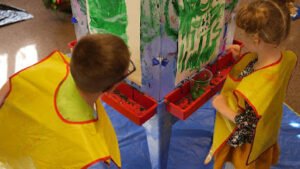
Art in primary school isn’t about producing perfect masterpieces—it’s about exploring materials, expressing ideas, and developing observational skills. Children work with various media: paint, pencils, clay, collage materials, and found objects.
Early art activities focus on exploration and experimentation. Children discover how colors mix, how different tools create different marks, and how materials behave. As they progress, teachers introduce more structured projects and artistic techniques. Children learn about famous artists, study different art styles, and attempt their own interpretations.
Art helps children express feelings and ideas that they might struggle to put into words. A child might paint their emotions about a story or sculpt what they imagine a character looks like. This emotional and creative expression is as valuable as the technical skills they develop.
Music
Music education in primary school involves listening, singing, playing instruments, and creating sounds. Children often start by exploring their own voices—learning songs, developing breath control, and experiencing rhythm through singing.
Instrumental music is introduced gradually. Many schools use percussion instruments like drums, shakers, and xylophones in early primary years. Some children progress to learning recorder or other instruments as they move through primary school. The focus is on developing musical skills and confidence, not on creating concert performers.
Listening to different types of music helps children understand the breadth of musical expression. They might listen to classical music, folk songs, jazz, or world music. Teachers help them identify different instruments, notice rhythm and melody, and discuss how music makes them feel.
Physical Education
Physical education in primary school promotes fitness, coordination, and enjoyment of movement. Early primary PE focuses on fundamental skills: running, jumping, throwing, and catching. Children develop body awareness and learn to control their movements safely.
As they progress, children participate in organized games, sports, and movement activities. Dance is often included, helping children express themselves through movement and develop rhythm and coordination. The emphasis is on participation and improvement rather than competition, though friendly games and races do occur.
PE also teaches teamwork, fair play, and resilience. Children learn to cooperate with classmates, follow rules, and handle winning and losing gracefully. These social and emotional benefits are as important as the physical skills developed.
Additional Subjects and Activities
Many primary schools include computing or information technology lessons, where children learn basic computer skills and digital literacy. In some regions, a foreign language—often Spanish or French—is introduced in primary school, typically starting in the later years.
Personal, social, and health education (PSHE) is woven throughout the curriculum rather than being a separate subject in many schools. This includes lessons on healthy living, relationships, emotional well-being, and safety.
How It All Comes Together
The primary school curriculum isn’t compartmentalized into isolated subjects. Good primary teaching integrates subjects, showing children how different areas of learning connect. A unit on ancient civilizations might include history, geography, art, and creative writing. A science investigation about plants might connect to mathematics through data collection and measuring.
This integrated approach helps children see learning as meaningful and interconnected, not as a collection of separate facts. It also keeps learning engaging and relevant to children’s lives and interests.
Understanding what subjects your child learns in primary school helps you appreciate the breadth of their education. Primary school aims to develop well-rounded learners with a strong foundation in literacy and numeracy, curiosity about the world, creative expression, and positive social skills. These years are about building confidence, fostering a love of learning, and developing the abilities that will support all future education.
Subjects Taught in Primary School
Core Academic Subjects
Mathematics
- Arithmetic and basic calculations
- Number systems and place value
- Addition, subtraction, multiplication, and division
- Introduction to fractions and decimals
- Basic geometry and measurement
- Problem-solving skills
Language Arts/English
- Reading and comprehension
- Writing and composition
- Grammar and spelling
- Phonics and vocabulary development
- Literature and storytelling
- Speaking and listening skills
- Handwriting
Science
- Life sciences (plants, animals, human body)
- Physical sciences (matter, energy, forces)
- Earth and space science
- Weather and seasons
- Environmental studies
- Basic experiments and scientific method
Social Studies
- History and cultural studies
- Geography and map skills
- Civics and government basics
- Community and family structures
- Cultural diversity
- Local and national history
Creative and Physical Subjects
Arts
- Visual art and drawing
- Painting and sculpture
- Crafts and design
- Art history appreciation
Music
- Singing and vocal training
- Musical instruments
- Rhythm and beat
- Music appreciation
- Performance
Physical Education
- Sports and games
- Fitness and movement
- Motor skill development
- Health and wellness
- Team activities
Additional Subjects
Computer/Information Technology
- Basic computer skills
- Typing and keyboard proficiency
- Digital literacy
- Introduction to coding (in modern curricula)
Foreign Language (in some schools)
- Basic vocabulary and phrases
- Simple conversation skills
- Cultural introduction

Related Articles