
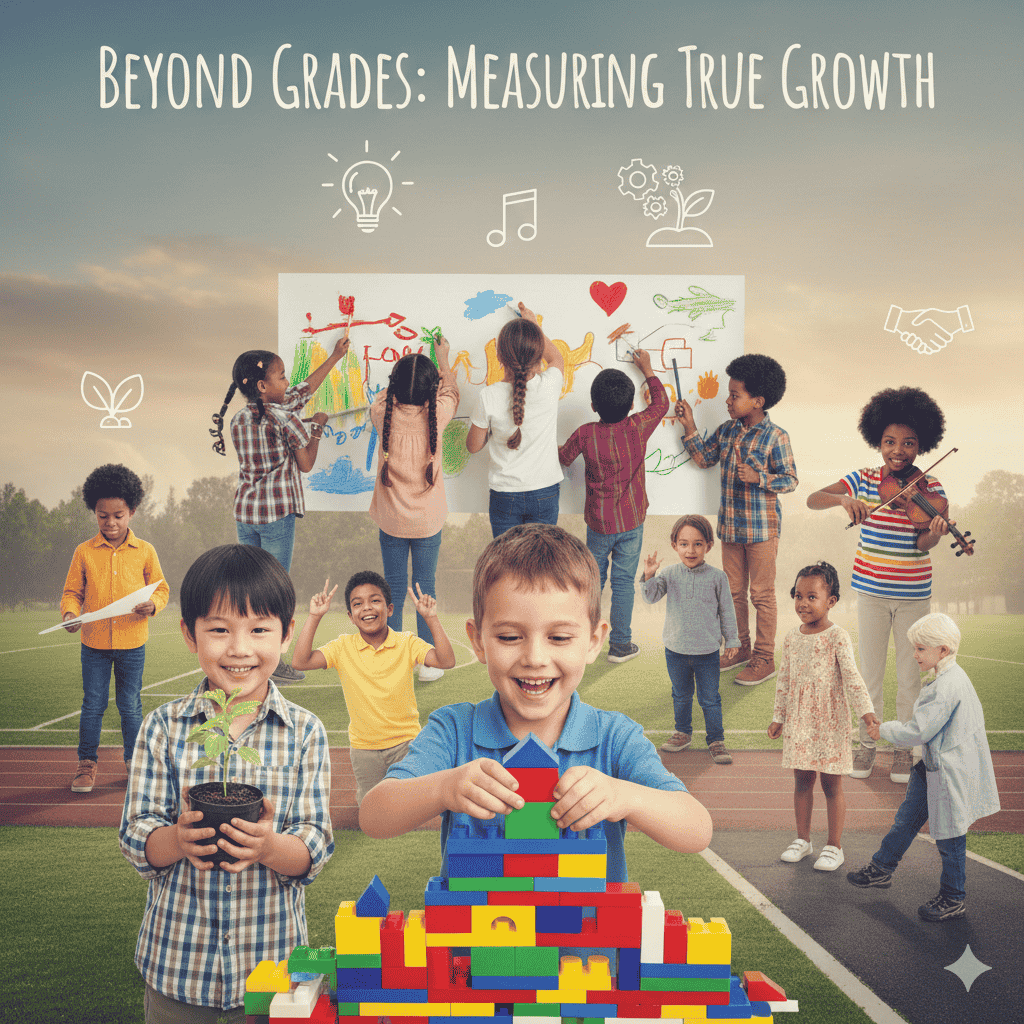
Every parent knows the feeling: report card day arrives, and suddenly a number or letter becomes the measure of their child’s entire educational experience. If that grade is an A, relief sets in. If it’s a C or lower, worry follows. But here’s what many parents and educators are beginning to understand—that single letter or percentage tells only part of the story.
The truth is that grades have become such a dominant force in education that we’ve largely forgotten what they actually measure. They’re snapshots, not full-length films. They capture performance on specific assignments and tests at specific moments in time, but they miss so much about what a child is actually learning and how they’re developing.
This article explores the broader picture of child development and academic progress, looking beyond the report card to understand what really matters when it comes to your child’s growth and future success.
What Grades Actually Measure
Before we can understand what grades miss, let’s be clear about what they do measure. Traditional grades typically reflect performance on tests, quizzes, essays, and class participation. They’re designed to give a numerical or letter representation of how well a student has demonstrated knowledge of specific curriculum content.
The problem is that this system was largely designed in the early 20th century and hasn’t fundamentally changed much since then. At that time, the goal was primarily to sort students into categories: college-bound or workforce-ready. The system wasn’t built to capture the complexity of how children actually learn and grow.
Most teachers do their best within this system, but even the most dedicated educator can only assign a letter grade. That grade compresses months of effort, improvement, struggles, and breakthroughs into a single symbol. It doesn’t distinguish between a student who understood the material immediately and one who struggled but persevered until mastery.
The Skills That Don’t Show Up on a Report Card
Consider a child who struggles with traditional test-taking but excels at solving real-world problems. Or a student who stumbles through math class yet demonstrates remarkable spatial reasoning and the ability to visualize complex structures. These strengths rarely translate into higher grades, yet they represent genuine intelligence and valuable skills.
Creativity and Innovation
When was the last time you saw a child’s creativity quantified as a grade? Most classroom environments reward students who follow instructions and produce correct answers. But creativity—the ability to think sideways, make unexpected connections, and come up with novel solutions—is increasingly what employers and higher education are looking for.
A student who writes a formulaic five-paragraph essay might receive an A, while another student who writes something more experimental and original might receive a B because it doesn’t fit the expected format. In the real world, that second student might be the better writer and thinker.
Resilience and Perseverance
How many times has your child failed at something before eventually succeeding? That process of bouncing back, learning from mistakes, and trying again is perhaps more important than any single test score. Yet traditional grades don’t measure resilience well at all.
A student might get straight As by playing it safe and only attempting work they know they can complete. Another student might have lower grades but is constantly challenging themselves, attempting difficult projects, and learning from failures. The second student is building resilience that will serve them far better in life than the first student’s higher grades.
Collaboration and Communication
In most modern workplaces, the ability to work with others and communicate clearly is essential. Yet many grading systems either ignore these skills entirely or give them minimal weight. A student might struggle with group projects because they’re shy or have processing differences, yet excel at one-on-one communication. These nuances get lost when everything collapses into a single grade.
The Impact of Different Learning Styles
One of the most important factors that grades miss is learning style variation. Not every child learns the same way, and not every classroom caters to every learning style equally.
Some children are visual learners who thrive when information is presented graphically or spatially. Others are auditory learners who need to hear and discuss information. Many children are kinesthetic learners who need hands-on experience and movement. A traditional classroom that relies heavily on lectures and written tests might systematically disadvantage several of these learner types, even though they’re perfectly capable of understanding the material when presented in their preferred modality.
A child might appear to be struggling academically when, in fact, they simply haven’t been taught in a way that aligns with how their brain works best. Their low grade reflects a mismatch between their learning style and the teaching method, not their actual capability or intelligence.
This is especially true for children with neurodivergence—those with dyslexia, dyscalculia, ADHD, autism, or other neurological differences. Many of these children are exceptionally intelligent but struggle with traditional testing and classroom formats. Their grades might not reflect their actual understanding or potential.
Beyond Grades: What Actually Predicts Success
Research in child development and educational psychology has identified several factors that are better predictors of long-term success than grades alone.
Growth Mindset
Carol Dweck’s research on mindset has shown that children who believe their abilities can be developed through effort (a growth mindset) tend to achieve more than those who believe abilities are fixed. A child with this mindset might initially get a lower grade on an assignment but will view it as information about what to work on next, rather than proof that they can’t do it.
Engagement and Curiosity
Students who are genuinely curious and engaged with learning tend to succeed in the long run, even if they struggle initially. A child who loves asking questions, exploring topics deeply, and pursuing their interests develops intrinsic motivation. This matters far more than obedience or the ability to memorize for a test.
Executive Function Skills
The ability to organize, plan, manage time, and regulate emotions predicts academic success better than IQ in many cases. Yet these skills aren’t captured in traditional grades. A student who struggles with executive function might understand the material perfectly but fail to turn in assignments on time.
What Parents Can Look for Instead
Rather than relying solely on grades, parents can observe and encourage several indicators of genuine progress.
Does your child ask questions about topics that interest them? Are they willing to attempt challenging tasks even when success isn’t guaranteed? Do they show understanding in conversations, even if it doesn’t translate to test scores? Do they persist when they encounter difficulty? Are they developing stronger relationships with peers and adults? Do they show initiative and self-direction in learning?
These observations paint a much richer picture of progress than any report card.
Parents can also look at how children demonstrate learning outside of school. Does a child who struggles in reading class spend hours reading about a favorite topic? Does a struggling math student create complex strategies when playing video games or sports? These real-world demonstrations of skill and understanding are valuable evidence of intellectual development.
The Role of Standardized Testing
The expansion of standardized testing has only intensified the focus on grades as the primary measure of progress. These tests are even more limited than traditional grades—they measure performance on a single day, often test knowledge in isolation from real-world application, and are particularly prone to cultural and socioeconomic biases.
Many educators and parents are beginning to push back against the over-testing that characterizes modern education. Some schools are experimenting with portfolio-based assessment, where students compile evidence of learning over time through projects, reflections, and demonstrations of understanding.
These alternatives provide a more complete picture of progress and often reveal capabilities that traditional tests miss entirely.
Creating a Balanced View of Progress
The most helpful approach combines grades with other observations and measures of progress. Parents and educators should use grades as one data point while also considering:
- Direct observation of learning and skill development
- Student portfolios and projects
- Self-assessment and reflection from the child
- Teacher observations beyond grades
- Demonstrated skills in real-world contexts
- The child’s level of engagement and motivation
Moving Forward
Grades will likely remain part of educational systems for the foreseeable future. They’re convenient, familiar, and required for college applications. But treating them as the only—or even the primary—indicator of a child’s progress is a mistake that can lead to unnecessary stress, misguided educational decisions, and a skewed sense of a child’s abilities.
By broadening your perspective on what progress means, you’ll develop a more accurate understanding of your child’s actual development and capabilities. You’ll also be better positioned to support their learning in ways that matter most—by encouraging curiosity, celebrating effort and growth, teaching resilience, and nurturing the whole child rather than just the aspects that show up on a report card.
Are Grades the Only Indicator of a Child’s Progress?
No, grades are not the only indicator of a child’s progress. Multiple dimensions should be considered to assess a child’s development comprehensively.
Other Important Indicators of Progress
Academic Indicators Beyond Grades:
- Understanding of concepts and mastery of skills
- Ability to apply knowledge to new situations
- Quality of work and improvement over time
- Participation in classroom discussions
- Completion and quality of assignments and projects
- Standardized test scores and assessments
- Reading level and literacy development
- Mathematical reasoning and problem-solving skills
Cognitive Development:
- Critical thinking abilities
- Creativity and innovation
- Memory and concentration span
- Logical reasoning
- Language development and communication skills
Social and Emotional Development:
- Ability to form and maintain relationships
- Cooperation and teamwork skills
- Empathy and emotional intelligence
- Self-regulation and impulse control
- Confidence and self-esteem
- Conflict resolution abilities
Physical Development:
- Motor skills (fine and gross)
- Coordination and athletic ability
- Overall health and fitness levels
- Developmental milestones
Character and Behavioral Indicators:
- Responsibility and accountability
- Honesty and integrity
- Effort and work ethic
- Motivation and engagement in learning
- Respect for others and authority
- Leadership qualities
Interests and Talents:
- Artistic abilities
- Musical talents
- Athletic prowess
- Special interests and hobbies
- Aptitudes in specific areas
Life Skills:
- Independence and self-care
- Organization and time management
- Decision-making abilities
- Resilience and adaptability
- Problem-solving skills

Leave a Reply